
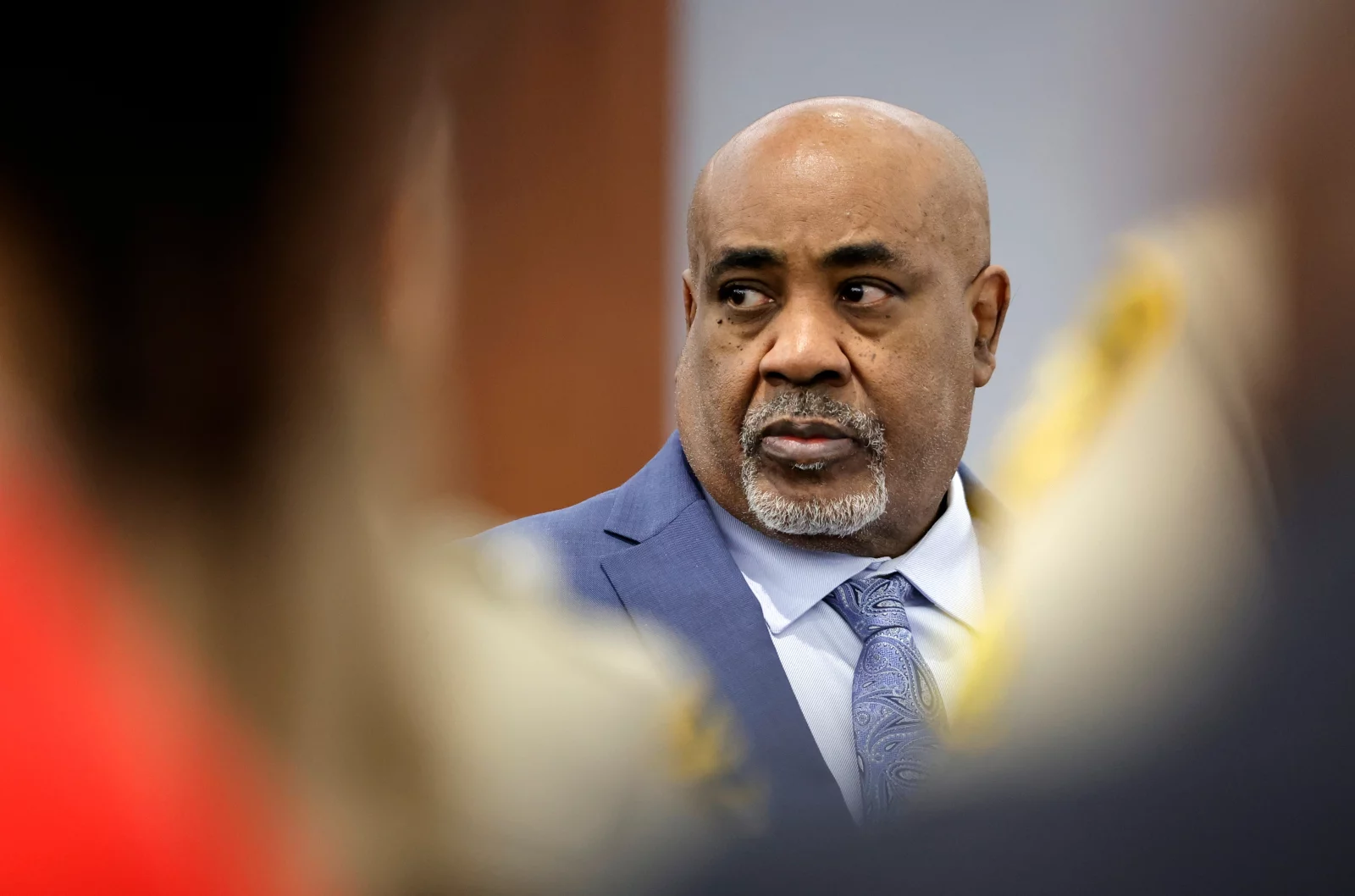
Duane “Keffe D” Davis is the first person charged in connection with Tupac Shakur’s 1996 killing as prosecutors and the defense prepare to present two very different versions of what happened that night in Las Vegas.
Nearly three decades after Tupac Shakur was fatally wounded in a Las Vegas drive-by shooting, the long-running mystery surrounding the rapper’s death is finally moving into a courtroom. Opening statements are set to begin Monday in the trial of Duane “Keffe D” Davis, who is charged with murder in connection with Shakur’s September 1996 killing. Davis, 63, has pleaded not guilty and is the first person ever charged in the case.
The trial is expected to last weeks, with prosecutors planning to call approximately 35 to 45 potential witnesses while the defense is expected to present a considerably smaller case. At the center of those proceedings will be a question that has remained unanswered in Hip-Hop for nearly 30 years: What really happened the night Tupac Shakur was killed?
Prosecutors allege that Davis orchestrated the shooting and provided the weapon, arguing that the killing was motivated by retaliation after Shakur and members of his entourage confronted and assaulted Davis’ nephew at the MGM Grand earlier that evening.
According to prosecutors, Davis was riding in a white Cadillac with three other men when the vehicle pulled alongside the BMW carrying Shakur and Death Row Records co-founder Marion “Suge” Knight. Gunfire followed, leaving Shakur critically wounded. He died six days later at the age of 25.
The other three men who prosecutors say were in the Cadillac have since died.
Importantly, prosecutors are not alleging that Davis was the person who pulled the trigger. Their case instead centers on the allegation that he helped organize the shooting and supplied the gun. Davis has maintained his innocence. His defense is expected to challenge one of the most significant pieces of evidence that helped revive the cold case: Davis’ own public accounts of the shooting.
In 2019, Davis published Compton Street Legend, a tell-all book that included details about his life and his alleged involvement in the events surrounding Shakur’s death. He also gave interviews discussing the shooting, effectively placing the case back into the public spotlight after years of unanswered questions.
Prosecutors argue that those statements helped investigators reconstruct what happened and ultimately led to Davis’ arrest in 2023. The defense, however, is expected to argue that the book should not be treated as a straightforward confession.
Attorney Michael Sanft has argued that Davis co-authored the book primarily as a means of making money and that portions of the story were fictionalized. He has also questioned how much of the book was actually written by Davis versus co-author Yusuf Jah.
That distinction could become one of the defining battles of the trial. Prosecutors acknowledge that the book contains sensationalized material, but they say their job will be to distinguish between what is true, what was exaggerated and what they believe to be false.
The conflicting accounts have become even more significant because Davis has recently told Las Vegas television station Fox 5 that he wasn’t actually present when Shakur was shot. A claim that appears to conflict with portions of his own book describing his trip from Los Angeles to Las Vegas, where he said he attended the same Mike Tyson fight as Shakur and documented events surrounding the shooting.
Those contradictions are likely to receive considerable attention as the prosecution and defense attempt to establish their respective narratives before a jury. But beyond the legal arguments, the beginning of the trial represents something much larger for the Hip-Hop community.
For nearly 30 years, Tupac’s death has existed somewhere between tragedy, unanswered questions and cultural mythology. His murder became one of the most infamous unsolved cases in music history, while the continued absence of an arrest fueled decades of speculation about who was responsible and why.
Through all of it, however, Tupac’s influence only continued to grow. He was just 25 when he died, yet his body of work helped establish him as one of the most influential and versatile artists in Hip-Hop history. He received six Grammy nominations, was inducted into the Rock & Roll Hall of Fame in 2017 and has continued to receive recognition well beyond his lifetime.
In recent years, his legacy has expanded even further. Tupac received a posthumous star on the Hollywood Walk of Fame, a street in Oakland was renamed in his honor, and his likeness and influence continue appearing throughout contemporary entertainment and popular culture.
That long lasting presence is one reason the trial has attracted so much attention. Members of Shakur’s family are expected to be in court for opening statements, despite the emotional difficulty of revisiting a tragedy that has followed them for decades. His stepbrother, Maurice “Mopreme” Shakur, recently described the experience of sitting through the trial as retraumatizing for the family, while emphasizing the importance of being there.
“We’re gonna stand by Pac as we always have,” he said.
That sentiment has also been echoed by friends, collaborators and fans who traveled to Las Vegas for jury selection. Darryl Harper, a veteran music producer who worked with Shakur at Death Row Records during the final chapter of his life, traveled from Georgia to attend the proceedings. Harper described Shakur as a personal friend and said his hope is simple. That the trial identifies the right person and provides some measure of justice.
Shakur’s cousins Kendrick Lesane and William Lesane also attended jury selection, with William expressing frustration that accountability has taken nearly three decades to reach this point. For many people who grew up with Tupac’s music, that frustration is understandable. His death wasn’t simply the loss of another recording artist. It was the loss of an artist whose work spoke directly to questions of poverty, racism, violence, politics, love, ambition and survival. Often all within the same body of work.
Tupac had already established himself as a cultural force before his death, but the mystery surrounding his killing became intertwined with his mythology. His rivalry with the East Coast rap scene, his relationship with Death Row Records and the larger tensions surrounding Hip-Hop in the 1990s have continued to shape how his final days are remembered.
Now, the courtroom will attempt to separate mythology from evidence. That distinction will matter. The prosecution will have to prove its case beyond a reasonable doubt. The defense will have the opportunity to challenge the credibility of witnesses, Davis’ previous statements and the interpretation of the evidence surrounding the shooting.
And ultimately, a jury will have to determine what and who they believe. For Tupac’s family, friends and generations of fans, the proceedings won’t erase nearly 30 years of unanswered questions. But they could finally provide something the Hip-Hop community has been waiting for since that September night in 1996… an opportunity for the truth to be heard in a courtroom. Tupac Shakur’s music has never stopped speaking. Now, nearly 30 years after his final chapter, the courtroom is preparing to tell its version of the story.